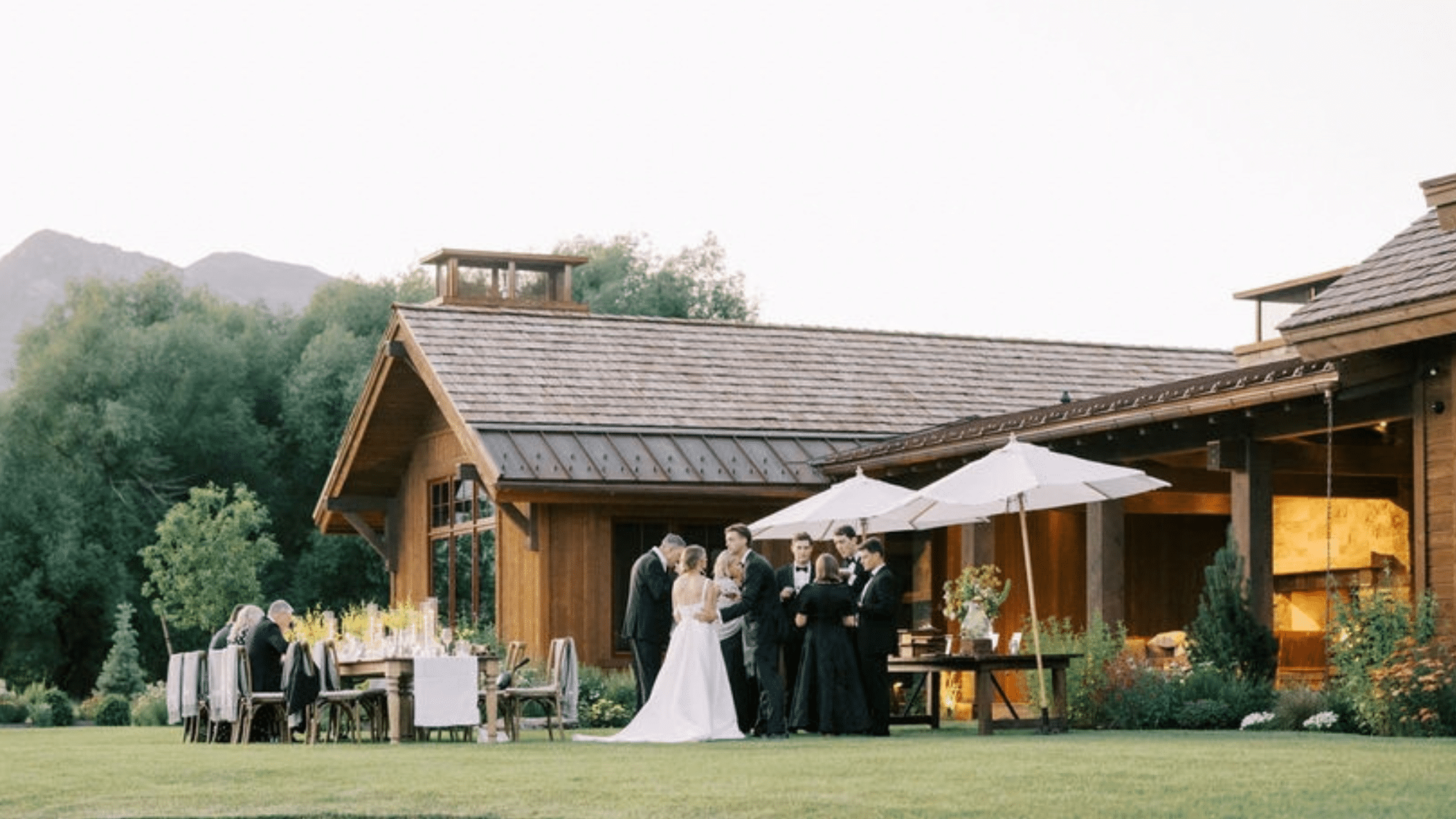
At Culinary Crafts, we’ve catered our share of big weddings. We routinely handle guest lists of 200-300, and once in a great while we do a wedding where the guest count is 800 or more. And yes, those weddings are spectacular—there’s a lot to be said for packing a venue full and having everyone who’s meaningful in your life there around you on your wedding day. But lately, we’ve been seeing more couples choose weddings that are intentionally small, with only a few dozen guests. These micro-weddings have a charm and intimacy all their own.
All photo credits for this article: Mikki Platt Photography
Last summer, we catered a micro-wedding in Heber City, Utah. It was small by almost any traditional wedding standard, with only about a dozen guests, but there was nothing small about the feeling of the day.
That experience made us think that it’s a good time to talk about this wedding trend and why couples are going small by design. So, let’s discuss your questions about micro-weddings.
Table of Contents
- What exactly is a micro-wedding?
- Why are couples choosing micro-weddings?
- How many guests should a micro-wedding have?
- Is a micro-wedding less expensive than a traditional wedding?
- How do I decide who to invite to a micro-wedding?
- What kind of menu and service style works best for a micro-wedding?
- Is full-service catering worth it for a small wedding?
- What are some things you can do at a micro-wedding that are difficult with 200+ guests?
- How can couples make sure their micro-wedding doesn’t feel like “just a dinner party”?
- What are the drawbacks of a micro-wedding?

1. What exactly is a micro-wedding?
There’s no official rule that turns a wedding into a micro-wedding, but generally speaking, a micro-wedding is a deliberately small celebration, often with 50 guests or fewer and sometimes with only a dozen or so.
But a micro-wedding isn’t simply a miniature version of a traditional wedding. Rather, it’s a different kind of wedding altogether, one designed around intimacy. Instead of trying to share their special day with as many people as possible, a couple can choose a few of their closest family and friends to share a closer, more personal experience.
In other words, small isn’t the defining feature of a micro-wedding. Intention is.

2. Why are couples choosing micro-weddings?
For some couples, a micro-wedding gives them the freedom to celebrate with the people who know them best.
A smaller guest list can be liberating. With fewer people to accommodate, couples can get more creative with everything from the venue to the menu. Instead of stretching a budget across hundreds of guests, they might prefer to splurge on an exceptional meal, a breathtaking setting, or those thoughtful details that make a celebration feel unmistakably theirs.
For couples who value connection over crowd size, a micro-wedding allows for more personal time spent with each guest. Conversations can linger. The celebration feels intimate without sacrificing the elegance or sense of occasion that makes a wedding a wedding.
3. How many guests should a micro-wedding have?
There is no number of guests that a micro-wedding “should” have; in fact, one of the main appeals of a micro-wedding is the freedom to choose what kind of experience the couple wants and how many guests they decide to share it with.
A micro-wedding with, say, fifty guests might be ideal for a full-feeling ceremony, a lively cocktail reception, and a rocking dance floor. On the other hand, a handful of guests may be all you want for an intimate vow ceremony followed by an exquisite chef-driven dinner around the same table, with one conversation that can encompass everyone.

Is a micro-wedding less expensive than a traditional wedding?
It certainly can be, but not necessarily. It all depends on your priorities.
Some wedding costs are unavoidably tied to the number of guests: food, beverages, rentals, place settings, and sometimes the size of the venue. Reducing a guest list from 200 people to 25 can obviously make a significant difference in your total price tag.
But couples often take those savings and invest them into a priority of their choosing. They may want to spend more per guest on a spectacular meal, beautiful rentals, exceptional wine, or whatever elements matter to them. At a micro-wedding, you’re more likely to see luxurious elements like a fresh oyster bar, a performance by a favorite musician, personalized guest gifts, an open bar with a personal mixologist, or an unforgettable afterparty. That’s one of the delightful things about a micro-wedding: you’re free to do what matters most to you.

5. How do I decide who to invite to a micro-wedding?
This may be the hardest part, deciding who to invite (or rather, who not to invite). When the guest list is small, every invitation becomes more significant. You can’t rely on the usual categories of “family, friends, coworkers, neighbors, plus-ones.” There simply isn’t room for everyone.
Remember that a micro-wedding isn’t supposed to satisfy everyone’s expectations. You’re creating an intentional, intimate gathering, and the guest list should include the people who need to be present for that experience to happen. A useful approach is to ask: Who would we genuinely miss if they weren’t there?
It’s not a formula. It’s not even a list of who has played the most significant roles in your lives. Ultimately, it comes down to the people you can’t imagine experiencing the day without. Who will you want to look across the table and see? Who will make the celebration feel complete?

This is where a small guest count can be wonderfully liberating. With only 20 or 30 guests, you’re not worried about efficiently feeding a crowd and keeping everyone moving through a buffet line. Instead, you can really think about the meal as an experience.
Maybe you want to build the menu around a favorite cuisine, seasonal ingredients, family recipes, or a particular culinary experience. Maybe you want the food to help represent you and your partner, or to tell your shared story.
A beautifully plated multi-course dinner can lend gravity to mark the occasion as truly special. On the other hand, a family-style meal can encourage conversation and interaction. Passed hors d’oeuvres can make cocktail hour feel relaxed and personal, while chef stations can bring a little theater and interest to the evening.
Ultimately, the best service style is the one that matches the couple and the setting. The beauty of a micro-wedding is that you have more room to make that choice based on what feels right, rather than what works most efficiently for 200 people.
7. Is full-service catering worthwhile for a small wedding?
We’d argue that full-service catering can be especially valuable for a small wedding.
It might be easy to assume that a dozen or so guests means you can handle everything yourself. But the smaller the gathering, the more personal the event becomes, and the more noticeable it is if the hosts aren’t fully present. Forty years of catering weddings have taught us this: it’s worth bringing in the right help so that the couple and their families aren’t stuck working their own wedding.
Full-service catering isn’t simply about putting food on plates. It’s about taking care of the behind-the-scenes work like setup, rentals, coordination, food preparation, service, clearing, timing, cleanup, and all the little things guests never see. If you’re going to invite only 20 people to your wedding, you should get to spend the evening with those 20 people, not running around trying to put out fires.

8. What are some things you can do at a micro-wedding that are difficult with 200+ guests?
Oh, the possibilities!
First of all, there are the obvious possibilities that a small guest list opens up. You can build the entire evening around conversation and connection. Everyone can sit at one table. The couple can personally greet and have unhurried conversations with every guest. Dinner can unfold at its own pace instead of being engineered around moving hundreds of people through a meal.
But also, there’s a wide range of wedding possibilities that simply don’t scale well. For example, at a micro-wedding it’s much easier to:
- Host dinner in a private home or backyard.
- Hold the event at an unusual venue with special meaning like an art museum, the gym where you met, a restaurant dining room, a mountain cabin, a rooftop, a wine cellar, a park campsite…your imagination is your limit!
- Serve a more elaborate, multi-course meal.
- Include personalized, hand-written Thank You notes at each guest’s place.
- Have the chef interact directly with guests.
- Customize dishes for individual guests.
- Spend more time on tablescape and presentation.
- Let dinner stretch into a leisurely evening.
- Share things with personal meaning, like the Norwegian kransekake (almond ring cake) that this couple cut for their guests.
- Build the menu around personal or family stories.
- Create a truly intimate wine or cocktail experience.
- Move the celebration between different locations throughout the evening.

9, How can couples make sure their micro-wedding doesn’t feel like “just a dinner party”?
A micro-wedding doesn’t need to imitate a large wedding, but it does need to have a sense of occasion, a feeling that guests are attending something truly special.
At a large wedding, the sheer number of guests helps to create that sense of occasion. When they walk in and see 200 other attendees, they immediately feel that something special is happening. You can make your micro-wedding feel just as momentous, but it takes some effort and planning. Beautiful tablescapes, flowers, lighting, music, thoughtful stationery, elevated food and beverage, and a carefully considered timeline can all help create that feeling. So can personal rituals: a custom ceremony, meaningful toasts, a first dance, cutting the cake, or whatever traditions matter to the couple.
But don’t overdo it. A micro-wedding gains its sense of occasion not from spectacle but from intimacy and intention. A few thoughtful, personal touches can mark the moment as unique and important. The goal isn’t to make 20 people feel like 200. It’s to make 20 people feel like they’re part of something extraordinary.

10. What are the drawbacks of a micro-wedding?
There are some drawbacks to a micro-wedding, and it’s worth acknowledging them.
The obvious downside is that you can’t invite everyone. If having your entire extended family, your college roommates, your coworkers, and 200 friends on the dance floor is part of your dream, a micro-wedding probably isn’t going to scratch that itch.
There can also be difficult feelings around the guest list. Someone will inevitably wonder why they weren’t invited, and deciding who makes the cut can be harder than couples anticipate.
Finally, there’s a certain energy that comes from a big wedding that an intimate wedding simply can’t replicate. Two hundred people celebrating you is a spectacle. Twenty people celebrating you is something else entirely.

The Heber City wedding pictured in this article was beautiful, moving, and unforgettable. From the ceremony to the menu to the personal little details that appeared everywhere (next to table settings, inside a jacket lining, under the brim of a hat), every detail had been brought together with love and forethought.
A Homecourt Advantage
This wedding didn’t need a traditional venue to feel special; the small guest list allowed the couple to hold it in the family’s backyard—and that meant a distinct homecourt advantage. The family backyard venue came pre-loaded with meaning and a lifetime of memories. Guests felt completely comfortable and welcome. And, at the end of the evening, there was no rush to wrap things up and clear out before the venue closed.
Sometimes the venue that feels most like home is…home.

The Case for Keeping It Small
Big weddings can be wonderful. There’s something exhilarating about filling a room with everyone you know and love. But for some couples, the most meaningful, magical, memorable wedding will come from keeping it small.
The rise of micro-weddings has shown exactly how intimate and personal a wedding can be. The people around the table aren’t faces you hope to catch during cocktail hour; they’re the people you most want next to you, the ones you will picture when you remember one of the most important days of your life.

